Menu
Book a Putter Fitting
Could narrow-gate training be a form of shock therapy for your putting stroke?
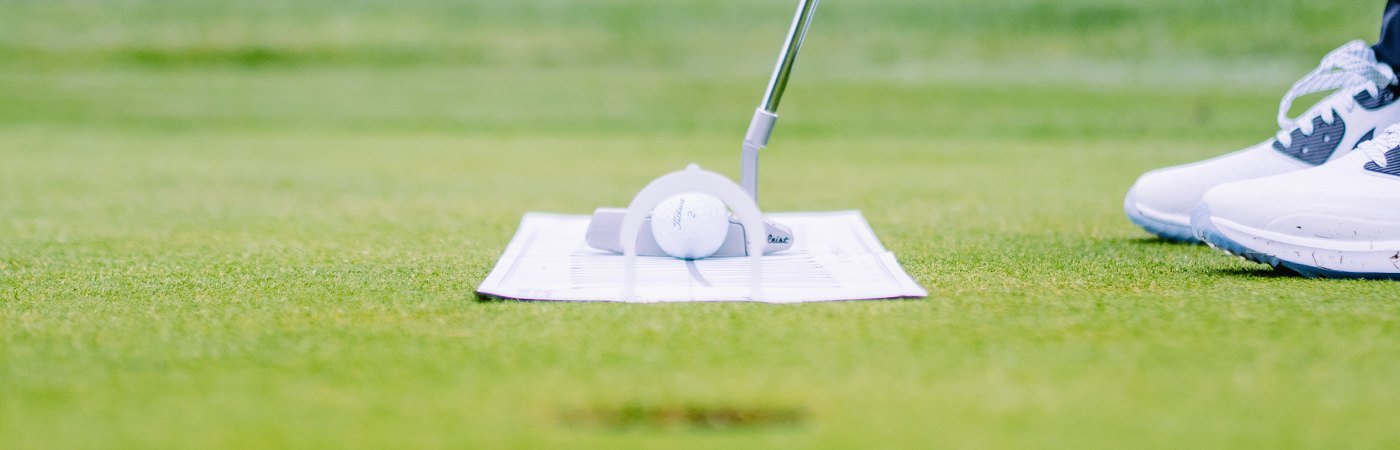
Putting arc templates with ball start line gates are one of the most popular tools in modern practice, and for good reason. They give instant, objective feedback. Through the gate, the start line was good. Clip a gate, something went wrong.
But our research is showing this could be doing more harm than good, causing a player to become tight and anxious, and too focused on avoiding error instead of creating a free-flowing stroke and a target-focused mindset.
Take a typical session. The player sets an arc template from a popular, well-known brand 10 ft from the hole, with the ball gate 30 cm (12 in) in front of the ball, and dials it to one of three settings: 1°, 0.75° or 0.5° of start-line error.
The gate sits in clear view at address, only a few millimetres wider than the ball. It looks extremely narrow, and that alone can make a player anxious and tight before the putter has even moved.
Classic avoidance training. The objective has quietly changed. The golfer is no longer trying to hit a target. They are trying to avoid missing, and the tighter the setting, the more tension it can create.
If yip-like signs appear, stop using the narrow gate immediately. This includes freezing over the ball, jerks, sudden grip tightening, false starts or a fear of the gate. Persistent involuntary movement deserves a proper professional assessment, not just a technical fix.
"I want to start the ball here."Creating a movement.
"I mustn't hit the gate."Preventing a movement.
Aversion therapy pairs a behaviour with an unpleasant consequence, classically a mild electric shock, until the person learns to avoid the behaviour.
Clipping the ball gate is not a shock. But the learning signal works the same way: instant, unmistakable and attached to a tiny error. Repeat it hundreds of times and you are not building a movement towards a target. You are conditioning sensitivity to making the wrong one.
Research on attentional focus suggests that a focus on the intended outcome holds up better under pressure than a focus on the movement itself.
Aversion training is designed to make people stop doing something. Over a putt, that leaves the player error focused, not target focused.
Maybe it is. Having the gate further down the target line could be a good option. The gate appears much wider and reads as a fair challenge, not a threat. See the LSR ZERO·ZERO GATE drills.
Another option is to use the hole as a natural gate. On a straight 10 ft putt rolled at die pace, the hole allows 1.01° of start-line error. That is the same room for error as having the narrow gate 5.2 mm either side of the ball at 30 cm, without a ball gate sitting in view at address, potentially causing stress and anxiety.
A practice session could look like this:
Free‑flowing stroke, target‑focused mindset.
The dot is a target, not a threat. Nothing punishes a miss and there is nothing to avoid, so attention stays on where the ball is going. That is target-focused practice, the opposite of aversion training.
See how the LSR ZERO·ZERO GATE works.
How the LSR gate worksResearch note The evidence supports the concerns about attentional focus, pressure and the multifactorial nature of the yips. It does not establish that narrow gates cause the yips. The question is whether a punishing practice environment feeds the very tension a vulnerable player is fighting. Treat the link as a coaching hypothesis to be tested, not a fact.
Gate figures Ball Ø42.67 mm (1.68 in), gate 30 cm (12 in) in front of the ball, width measured between the inside faces of the gate.
My blog