Menu
Book a Putter Fitting
Putting
The putting feel behind the purest stroke of all time.
Jim Flick with Tiger Woods
Before the 2009 Memorial, Jim Flick watched Tiger Woods practise on the putting green. The roll was very pure. Putts that caught the edge dropped instead of spinning away. Flick asked him how he did it.
"I think of hitting a high draw on my putts."
Tiger Woods, 2009 Memorial
"...and I control the putter with my right hand, like that man over there." The man was Jack Nicklaus. Flick described it like this:
"Like Jack, Tiger lets the putter swing back slightly to the inside, then he feels the face closing slightly as he swings the putter down the line — not back to the inside — with his right hand."
Jim Flick, Golf Digest, 2009
70° plane · r 1300 mm · 3°+ AoA
Take a stroke on a 70° plane, 1300 mm radius, hitting up 3°.

Our analysis
Tiger's words were high, draw and down the line. Here is our interpretation of the described feels.
Ball ahead of the low point
The low point of the stroke was 7 cm behind the ball, with a +3° AoA. That is the exact feel of hitting a shot high.
Swing direction 1.09° right
To create a 0° path at impact with a 70° plane and a +3° AoA, the swing direction must be 1.09° right. See the D-plane image below. From the low point to the ball the arc turns towards the target as the attack angle reaches +3°. Over the 72 mm from the low point to the ball the face closes 1.09° and stays square to the path.
We think Tiger felt like a draw because the difference between the swing direction and the face angle was 1.09° at impact.
Most PGA Tour players are aware of this feel with the driver. The SD must be more right when the AoA is positive.
cvg point · 72 mm behind the ball
At the low point three numbers should line up perfectly: swing direction, path and face. In this simulation of Tiger's stroke they are all 1.09° right. We call it the cvg point, short for convergence point.
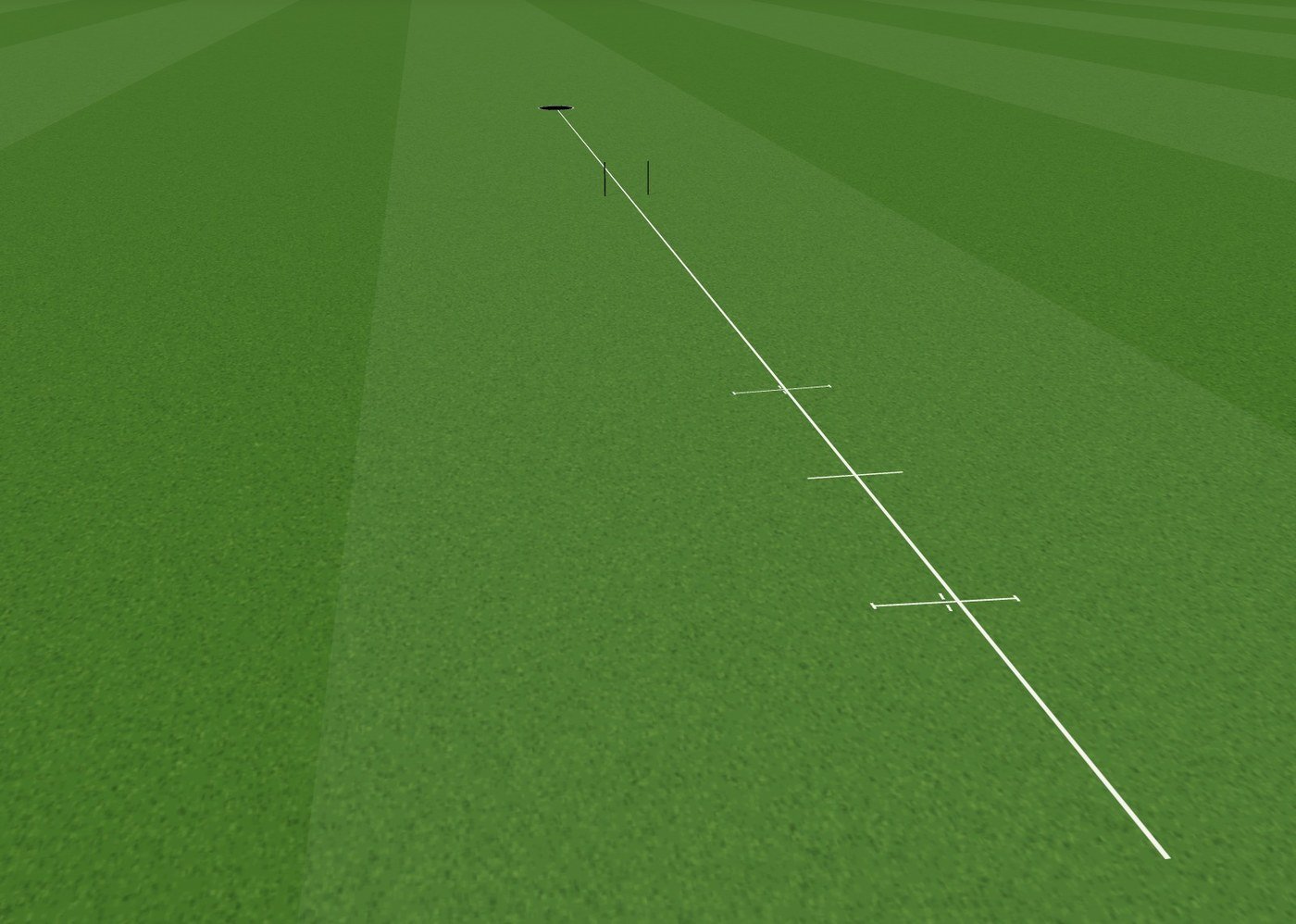
This is the true delivery position for putting. From here the face can square up perfectly to the target and stay square to the path through impact. Below is a diagram showing the face and path 7 cm before and after impact. The arc is drawn 4x stronger so the rotation is easier to see.

| cvg point | Impact | |
|---|---|---|
| Swing direction | 1.09° R | 1.09° R |
| Path | 1.09° R | 0.0° |
| Face | 1.09° R | 0.0° |
| Attack angle | 0.0° | 3.0° up |
Then the arc takes over. In the 72 mm to the ball it turns 1.09° back left, so path and face arrive at zero together.
Under 1 mm off the line
After impact the putter travels down the target line, only separating from the target line by 0.7 mm at 7 cm after impact. That is why Tiger felt like he was swinging straight down the line through impact.

Tiger Woods
Tiger Woods · 2019 – 2023
Tiger has said the same thing for years.
"I have to make sure I release the club. I have to make sure I can put some right hand into this."
2019 Masters, 12th hole, watching it back on CBS
"It's such a good feeling when I get a lot of right hand in that putt and release it."
2019 Masters, 16th hole
"I just hate that blocky feeling... So I go back to hooking my putts and it felt like my normal stroke."
2023 Genesis Invitational
High draw, release, hooking it. All the same feel: the face closing with the arc into the ball. The miss he hates, the block, is the face and path staying right.
Learning from the best
When the best player of all time describes a feel, there is most probably something fundamentally correct behind it. In this case Tiger was spot on with his feel to produce a zero face and zero path at impact.
My blog